 |
South Central Llama Association
|
|
Members and Their Llamas Make the News February 13, 2012. Longtime SCLA member and llama lover, Eleanor Kanis, passed away. Her daughter, Karen Conyngham, SCLA membership secretary, wrote her obituary.August 14, 2011. See article Manor couple open doors to overheated pet llamas about Sharon and Claud Bramblett's Mesquite Bean Llamas showing some of their llamas in their house during the extraordinarily hot Summer 2011 in central Texas. Looking at Llamas: Ranch herd becomes show herdBy CAROLYN ROST, Country World Staff WriterJune 19, 2008 - When Chuk and Vicki Guzman look out into their pastures, they love what they see - their lovable llamas. Some are kushing (lying down), some are grazing and some are just chewing their cud. For the Guzmans, llamas became a big part of their life when their youngest child left for college. “I was a stay-at-home mom for years. Very involved in the schools and with my kids and everything they did. When our youngest daughter was going to go to college, she said I couldn’t go with her, so I had to find something to do,” Vicki said. (Llamas at Southern G Llama ranch have become a favorite of owners Chuk
and Vicki Guzman. The ranch’s first llama came as part of a cattle sale.
Later, they purchased several more, and went into the llama businessafter
purchasing a show-quality herd. --Staff photo by Rost)
Chuk, she said, had horses and cows, “and I didn’t really want to help him with that. I wanted my own thing.” Her “own thing” turned out to be llamas. According to Vicki, her love for the animals began after seeing them at a stock show. “Our daughter was showing lambs one year at the San Antonio Stock Show. We went walking around and saw llamas. I fell in love with them.” As it turned out, a few years later Chuk happened across a llama while buying some cattle. “I bought a group of cows and the lady that I bought them from had a llama with them as a guard llama. He came with the herd.” So, Chuk said, they kept Old Charlie at the house by the horse barn. “He just kind of took over the place,” Chuk said with a laugh. Then, he said, Vicki heard about a couple that was retiring and selling their herd. “She said, ‘well, I’d like to get some more’ and it just kind of took off from there.” “They sold practically the whole herd to us,” Vicki said. “After a couple of years, we realized what we bought were pet quality and not show quality. We wanted to show, so they are now our retired herd. They live 15 to 20 years, so some of them are getting up there.” Today, Southern G Llamas, located near La Grange in Fayette County, has about 50 llamas which includes the retired herd and show stock. According to the Guzmans, caring for llamas is the same as caring for any
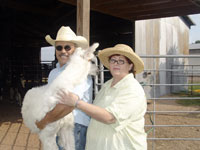
other animal. “It is a big commitment ... but basically they are as easy as any other animal,” Vicki said. “Just basic things for an animal,” Chuk added. “They have to be de-wormed. They have to be vaccinated once a year. Their toenails need to be clipped to make sure they don’t grow too long and teeth looked at. Just basically whatever you would do for another animal - general health wise.” (Chuk and Vicki show off Marty Bowtie, one of their favorite llamas at the ranch. --Staff photos by Rost) When it comes to reproduction cycles, however, llamas are different than other livestock. “They don’t have a normal heat cycle like a regular horse or cow,” Chuk explained. “Not until they are put with a stud do they start their cycle, so you are able to control their breeding.” Once a female is bred, she is pregnant for 11 1/2 months. Because of this, the Guzmans try to breed them at certain times. “Because they do carry it so long, we don’t want them to have them in the summertime or dead of winter,” Chuk said. “It’s better in the cold than in the heat, but we try to have them bred early spring or late fall.” Heat can also affect the health of a llama. Because of their wool coat, llamas are prone to heat stress, Vicki said. As soon as it starts getting hot, the sheering begins. In the summer time, the Guzmans also provide fans for the show stock. “There is sand in the barn and we wet it down in the morning or afternoon. When it gets really hot, they will come back in the barn and lay in front of the fans.” For the retired herd, she said, “there is a tank out there and they go out and stand in it all afternoon.” As well as having their wool sheared and fans to help cool their bodies, some of the llamas, including the bred females, show stock and studs, get a cool vacation in New Mexico. “They go up the mountains where it’s about 8,000 feet and they stay there,” Chuk said. Depending on the weather here, he said, they will take them around the first of June and then bring them back the first or second week of October. “We can’t afford a vacation because our llamas get to go to summer camp,” Vicki said with a laugh. When it comes to selling their llamas, the Guzmans are “particular” about who they sell to. “If we really pushed it, we would advertise,” Chuk said, “but we are particular about who gets our animals. If they are sold within the llama community, it is better. So we just kind of stay within that circle.” When selling their animals, the couple tries to match the llama to the buyer. “We talk to them first,” said Vicki. “I try to match the personalities and what they want them for. If one girl comes out here and she wants it just strictly to walk around her pasture because she looks pretty, then I know which llama would fit that better. Or whether they want one to guard or they want one for their kids. Some have better dispositions than others, just like any animal.” For people wanting livestock for agricultural exemption, Chuk said, llamas can now be claimed. “They have just now gone through the legislature just last year and passed a law where they are not considered an exotic animal anymore. They are considered livestock now. If you have llamas, you can use them as an ag exemption.” According to the Guzmans, llamas are used for many purposes. “They do offer predator control. They will run off coyotes and guard stock,” Chuk said. “They are pack animals, too,” added Vicki. “They are from the Andes down in South America and they were originally for packing. They would bring goods down from the mountains and back up. A lot of people, especially in the colder states, take them on hikes.” Some people, she said, even use llamas as caddies. Along with protecting and packing, there’s one more thing llamas offer. “There’s always the pet aspect of it where they can become pretty good companions for the family,” Chuk said. “They are a kind of docile type animal. They kind of just sit around and if they are really content, they’ll do this humming noise — kind of a therapeutic type of noise.” Or, Vicki said with a smile, they just sit around and do nothing. “They sit around and chew cud a lot. Graze and chew cud.” http://www.countryworldnews.com/news/2008/6-June/0619Llamas.php |
| E-mail:info@scla.us
SCLA is a 501(c)(5) Non-Profit Organization
Web Designer: Sharon Bramblett Updated: Fri 17-Feb-2012 15:46 ©2009 South Central Llama Association |